
Vanguard Roth IRA open account steps work like this, with a practical example
Learning how to get yout Vanguard Roth IRA open account before applying helps set realistic expectations about contribution limits and tax treatment.
2026 Ram 1500 Express with cab, engine, equipment, parking and maintenance factors to compare before choosing a full-size pickup.
This guide explains how a Roth IRA works at Vanguard, walks through a practical example, covers risk and liquidity considerations, and helps compare it with other retirement account options, without promising any specific return.
How to complete a Vanguard Roth IRA open account application 🔎
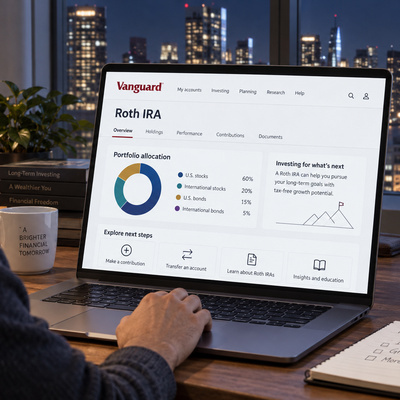
A Roth IRA is a retirement account funded with after-tax contributions, meaning qualified withdrawals in retirement are generally tax-free, subject to IRS rules on contribution limits and income eligibility.
Opening one at Vanguard typically involves an online application, providing identification and bank information, and choosing investments such as index funds or ETFs once the account is funded.

Vanguard Roth IRA open account steps, minimums and sample allocation 📊
Imagine an investor who opens a Vanguard Roth IRA and contributes $500 monthly into a diversified index fund, in a period when the Federal Reserve has set the federal funds rate at 3.75%-4.00% following its September 16, 2026 decision.
This example is illustrative only: actual returns depend on market performance, the specific funds chosen, and the interest rate environment can change the relative appeal of bonds versus stocks within the portfolio.
| Key information | Practical summary |
| Account type | Individual retirement account funded with after-tax money |
| How to open | Complete Vanguard’s online application, provide personal and bank details, name beneficiaries, fund the account and choose investments |
| Opening cost | Vanguard states that there is no charge to open an IRA |
| 2026 contribution limit | US$7,500 across all Traditional and Roth IRAs |
| Additional age-50 contribution | Up to US1,100,foratotalofUS8,600, subject to applicable rules |
| Roth income limits — single/head of household | Phaseout from US153,000toUS168,000 of modified adjusted gross income |
| Roth income limits — married filing jointly | Phaseout from US242,000toUS252,000 |
| Tax treatment of contributions | Contributions are not deductible because they are made with after-tax money |
| Qualified withdrawals | Generally tax-free when the applicable five-year rule and qualifying conditions are met |
| Investment options | Vanguard mutual funds, ETFs and other eligible investments |
| Investment minimum | The IRA itself can be opened without a minimum; individual funds may impose separate minimums |
| Example contribution | US500permonthequalsUS6,000 per year before investment gains or losses |
| Main risk | Investments can lose value; the Roth IRA structure does not protect the account from market declines |
| Liquidity | Contributions and investment holdings have different withdrawal and market-risk considerations |
| Interest-rate context | The Federal Reserve raised its target range to 3.75%–4.00% on September 16, 2026; this may affect market conditions but does not change Roth IRA tax rules |
Context before opening ✍️
- Separate the account from the investment: Opening a Roth IRA establishes the tax-advantaged account structure. Choosing a fund, ETF or other investment determines the portfolio’s market exposure.
- Check eligibility first: Roth IRA contribution limits depend on income, filing status and age. The annual limit applies collectively to Traditional and Roth IRAs, not separately to each account.
- Use the example carefully: Contributing US500monthlywouldtotalUS6,000 in 2026, leaving US1,500belowthestandardUS7,500 limit. This is only a contribution example, not a projected return.
- Understand the tax trade-off: Roth contributions generally provide no upfront deduction, but qualified withdrawals are generally tax-free. Traditional IRA contributions and withdrawals follow different rules.
- Review withdrawal rules: Contributions, earnings and qualified distributions are not treated identically. Early withdrawals of earnings may result in taxes or penalties unless an exception applies.
- Match investments to risk: Stock funds may offer greater growth potential but can decline sharply. Bond funds and money-market investments also carry risks and may respond differently to interest-rate changes.
- Confirm costs and minimums: Vanguard does not charge to open an IRA, but individual funds may have investment minimums, expense ratios or other conditions.
- Verify current rules: Contribution limits, income phaseouts, tax treatment and Vanguard product details can change. Confirm them with Vanguard and the IRS before contributing or transferring retirement assets.
Investments held within a Roth IRA, such as stock or bond funds, carry market risk and can lose value, and early withdrawals of earnings before retirement age may trigger taxes and penalties under current IRS rules.
Liquidity also depends on the underlying investments chosen — a money market fund is more liquid than a long-term bond fund held within the same account.
Vanguard funds versus other Roth IRA choices 📈
Compared to a Traditional IRA, a Roth IRA trades an upfront tax deduction for tax-free qualified withdrawals later, which tends to favor investors who expect to be in a higher tax bracket in retirement than they are today.
The right choice depends on current income, expected future income, and eligibility rules that can change annually.
Who may benefit from this retirement account ✅
A Vanguard Roth IRA tends to make sense for younger investors or those early in their careers who expect their tax rate to rise over time, and who have already covered short-term savings needs.
Before allocating extra income, it’s also worth reviewing ChatGPT Business plans if the investor also runs a small business.
Opening the account establishes the retirement structure. The allocation chosen afterward determines market exposure, so the application and investment decision should be reviewed as separate steps.
- Confirm eligibility and the applicable contribution rules.
- Complete identity, beneficiary and funding information carefully.
- Decide whether the money will remain in cash temporarily or be invested.
- Compare funds by objective, cost and risk rather than provider name alone.
- Match the allocation to time horizon and tolerance for loss.
- Review withdrawal and tax rules before moving retirement money.
The sample allocation demonstrates a possible way to organize assets, not a required portfolio or expected return. Minimums can also differ by investment even when the account itself can be opened.
Keeping those layers visible prevents the tax treatment of the IRA from being mistaken for protection against market declines. Current rules and product details should be checked with the official provider and tax sources before a contribution or rollover.
FAQ ❓
- How do I open a Vanguard Roth IRA account?
- The process typically involves an online application with identification and bank details, followed by selecting investments once the account is funded; exact steps should be confirmed on Vanguard’s official site.
- Are Roth IRA contributions tax-deductible?
- No, contributions are made with after-tax dollars, which is why qualified withdrawals in retirement are generally tax-free under current IRS rules.
- Is there an income limit for Roth IRA eligibility?
- Yes, income limits apply and can change annually; current limits should be confirmed on the Investor.gov (SEC) website or with the IRS.
- Can I lose money in a Roth IRA?
- Yes, since the account holds investments like stock or bond funds, the account balance can go down as well as up depending on market performance.
- Does the Fed’s interest rate affect a Roth IRA?
- It can influence bond yields and overall market conditions, which affects the performance of fixed-income investments held within the account, though it does not directly change tax treatment.
